How to Stack Sandbags: Placement, Walls and Doorways
Updated · 6 min read
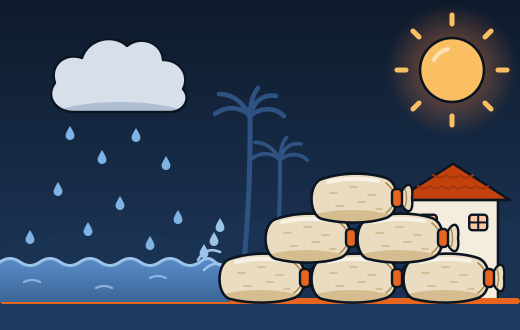
A sandbag wall doesn't have to be watertight to save your house. Its job is to slow water down and steer it around the places it does damage — doorways, garage doors, window wells and the low corner of the yard. Built properly, a knee-high wall does that job for hours. Built badly, water finds the gaps in minutes. Here's how to build it properly.
Before you stack: pick the line
Walk your property while it's dry and look for where water will actually go. Water moves downhill and takes the easiest path, so the spots that matter are usually obvious once you look: the driveway that slopes toward the garage, the patio that drains toward a slider, the side yard that funnels runoff from the neighbor's lot.
- Divert, don't dam. A wall that angles water around a structure and toward the street or a drain works far better than one that tries to hold water back. Holding water in place builds pressure; steering it lets it keep moving.
- Clear the ground first. Sweep away leaves, gravel and debris where the first row will sit. Bags seal against the ground, and debris becomes a leak path.
- Lay plastic sheeting on the water side if you have it. Run it under the first row and up the face of the wall; it makes the wall dramatically more water resistant.
How to lay the first row
- Place bags lengthwise along the line of the wall, end to end.
- Overlap each bag over the end of the one before it by about a third, so there's no straight seam for water to run through.
- Press each bag down firmly — step on it or tamp it with your hands — so it flattens and molds to the ground and its neighbors. A tamped bag is roughly four inches tall.
Stacking more rows: stagger the joints
Every row above the first is laid like brickwork: offset by half a bag so each joint sits over the middle of the bag below. Tamp each row as you go. Never stack bags in straight columns — the seams line up and the wall splits apart under pressure.
For anything taller than about a foot, build a pyramid: make the base roughly three times as wide as the wall will be tall, and step each row in as you go up. A two-foot wall needs a base about six feet wide. It takes a lot more bags than people expect — our sandbag calculator works out the number for any length and height.
Protecting a doorway
- Lay plastic sheeting across the threshold and out onto the ground outside.
- Place a row of bags across the opening, tight against the door frame on both sides.
- Add a second and third row, staggered, for a barrier about a foot high. That's usually 20–30 bags for a standard door.
- Fold the sheeting back over the top of the bags on the outside face.
Protecting a garage door
Garage doors let water under the bottom seal easily. Build the same doorway barrier across the full width of the door, and tie the ends into something solid — the wall of the house or the driveway edge. For a standard two-car door, plan on around 100–120 bags for a wall about a foot high.
Common mistakes
- Stacking bags against the house to hold back deep water. Deep standing water pushes on foundations and walls. Sandbags are for diverting runoff, not creating a pool against your home.
- Leaving gaps at the ends. Water finds the end of a wall. Tie walls into high ground, curbs or structures.
- Waiting for the rain. Stacking in a downpour is miserable and slow, and when a big storm is forecast, sandbags sell out across LA. Have them on hand before the season starts.
After the storm
Bags that sat in muddy runoff may be contaminated — handle them with gloves. Clean bags can be kept for next time: store them dry and out of direct sun, since polypropylene breaks down with UV exposure. For disposal of used sandbags and sand, check with your city's sanitation or public works department; don't empty them into streets or storm drains.