Living Below a Burn Scar: Sandbags, Mud and Debris Flows
Updated · 6 min read
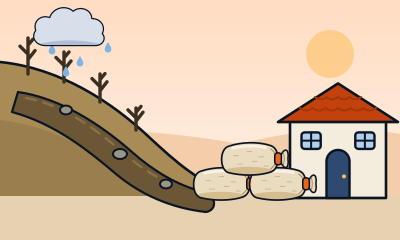
Wildfire changes how a hillside handles rain. Recent years have left large burn scars above communities across Los Angeles County — from Malibu and Pacific Palisades to Altadena and the San Gabriel foothills — and for the next several rainy seasons, homes below those slopes face a flood risk they didn't have before the fire.
Why burned slopes flood
Vegetation and its roots normally slow rain down and hold soil in place. A hot fire burns that away and can leave the soil surface water-repellent, so rain runs off instead of soaking in. Runoff picks up ash, soil and rock on its way downhill. With enough intensity, that becomes a debris flow — a fast-moving slurry of mud, rocks and vegetation that can carry boulders and cars.
The risk is highest in the first few years after a fire, until vegetation grows back, and it depends more on how hard it rains than how long. A short, intense burst of rain over a burn scar can trigger flows that a longer, gentler storm would not.
What sandbags can — and can't — do
Be realistic about this. Sandbags are excellent at handling runoff and mud flow: water and loose sediment moving across your lot. They are not a defense against a large debris flow. Nothing a homeowner can stack will stop tons of rock moving downhill. That's why the most important step is the simplest one: when officials issue an evacuation order for a burn area, leave.
What sandbags do well below a burn scar:
- Steering muddy runoff around the house instead of through it.
- Keeping water and mud out of doorways, garages and crawl-space vents.
- Channeling flow down a driveway toward the street rather than into the yard.
- Protecting slopes and yards from erosion during ordinary rain.
Building diversion walls
- Map the flow. Stand uphill of your house and trace where water will come from and where it can safely go — usually the street or an existing drainage channel. Never divert water onto a neighbor's property.
- Angle the wall. Set walls at an angle to the flow so water is deflected along them rather than hitting them head-on.
- Build low and long. A wall one to two feet high with a wide, pyramid base holds up far better than a tall, narrow stack. See how to stack sandbags.
- Protect openings last. Once flow is steered around the house, block doorways and garage doors with short barriers backed by plastic sheeting.
Get guidance for your property
Los Angeles County Public Works publishes a homeowner's guide to flood, debris and erosion control, and county and city agencies post burn-area storm information and evacuation maps before each rainy season. If your home sits directly below a burn scar, it's worth talking to a licensed engineer or contractor about permanent measures like deflection walls. And sign up for your area's emergency alerts — see our LA storm-prep checklist.
How many bags?
Diversion walls use more bags than people expect, because a proper wall is wide at the base. Measure the length you need to protect and use our sandbag calculator, then order before the first storm — when a burn-area storm is forecast, sandbags go fast.